



The 2026 Chinese Institute of Command and Control (CICC) Science and Technology Awards ceremony was recently held in Nanjing. A project led by Shanghai DS Information Technology Co., Ltd. (DS), “Key Technologies and Applications for Cognitive Decision-Making and Collaborative Command in Public Safety Risk Governance,” won the First Prize in the Science and Technology Progress category.
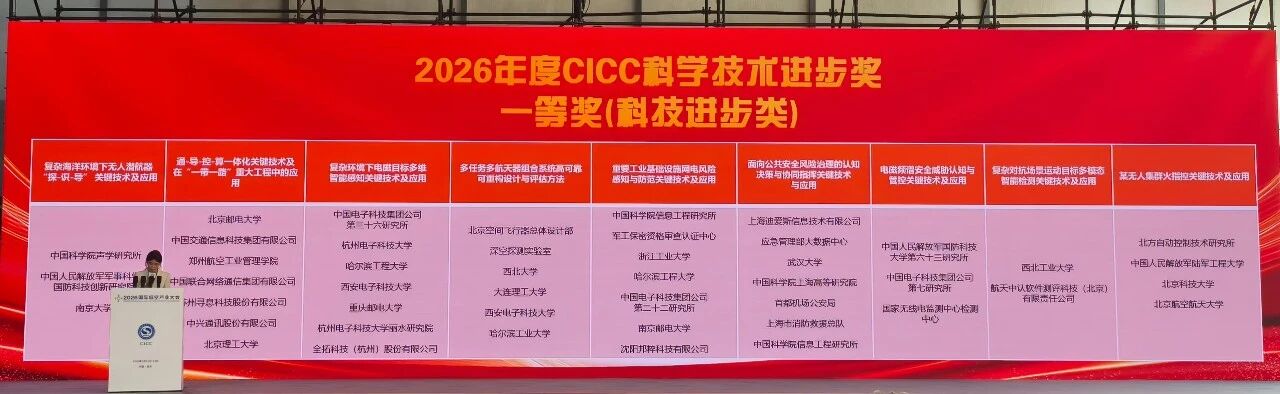
The project addresses major needs in public safety governance and emergency command. To overcome challenges in complex scenarios—such as fragmented information, insufficient risk awareness, limited decision support, and low collaborative response efficiency—DS and its partners carried out sustained industry-academia-research-application collaboration. They achieved innovations in all-domain data fusion, complex risk cognition and dynamic early warning, and intelligent decision-making and collaborative command, forming a digital-intelligent public safety technology system and application platform covering “perception, cognition, decision-making, and response.” The results have been applied in public security, emergency management, firefighting, urban governance, and major event security, providing strong support for risk monitoring and early warning, decision assistance, and collaborative response.
Founded in 2012, CICC promotes innovation, academic exchange, and application in command and control. It established the CICC Science and Technology Award in 2016 to recognize achievements with outstanding technological innovation and significant economic or social benefits.
This award is another important achievement of DS’s long-term work in public safety and emergency command and continuous innovation and technology transfer. It also reflects DS’s technical strength in digital-intelligent public safety, smart emergency response, and intelligent command.
Going forward, DS will continue to focus on public safety and emergency command, deepen the integration of AI, large models, multi-agent systems, and other frontier technologies with industry scenarios, accelerate the translation of innovations into operational applications, and contribute more to modernizing public safety governance.
